The Single Cell and Spatial Transcriptomics Core provides advanced technologies for mapping gene expression within intact tissue. Our spatial transcriptomics platforms include 10x Genomics Visium HD for high-resolution whole-transcriptome spatial profiling and Xenium In Situ for high-plex, single-cell and subcellular gene-expression imaging. We support investigators with experimental design, tissue preparation, data generation, and computational analysis to reveal how cell types, molecular states, and tissue architecture are organized in health and disease.
Spatial Transcriptomics
Spatial transcriptomics enables investigators to measure gene expression while preserving the anatomical location of cells and transcripts within intact tissue. By integrating molecular profiling with high-resolution tissue imaging, these technologies provide a powerful approach for studying cellular heterogeneity, tissue organization, cell-cell interactions, and spatially restricted disease processes.
Spatial Transcriptomics Services
The Single Cell and Spatial Transcriptomics Core provides access to state-of-the-art spatial transcriptomics platforms and supports investigators from experimental planning through tissue processing, data generation, quality assessment, and downstream analysis. Our spatial capabilities include both sequencing-based and imaging-based approaches, allowing investigators to select the platform best suited to their biological question.
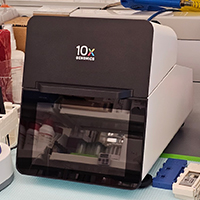
10x Genomics Visium HD
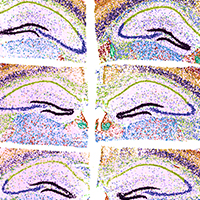
Visium HD is a high-resolution, whole-transcriptome spatial gene expression platform. Tissue sections are placed on a spatially barcoded capture area, allowing RNA molecules to be assigned back to their locations in the tissue. Visium HD provides genome-wide expression information at near-single-cell spatial resolution and is particularly well suited for discovery studies in complex tissues.
Potential applications include:
- Mapping cell types and transcriptional states across anatomical regions
- Identifying spatially restricted gene-expression programs
- Comparing control and disease tissues while preserving tissue architecture
- Characterizing tumor, immune, vascular, neural, and other tissue microenvironments
- Integrating spatial data with single-cell or single-nucleus RNA sequencing datasets

10x Genomics Xenium In Situ
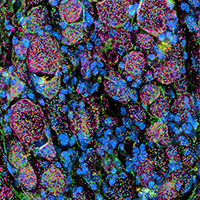
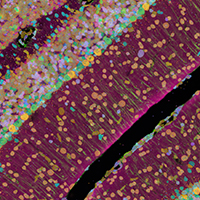
Xenium is a high-plex, imaging-based in situ gene-expression platform that detects individual RNA transcripts directly within tissue sections. The platform combines subcellular transcript localization with cell segmentation, enabling spatially resolved analysis of hundreds to thousands of genes at single-cell resolution. Xenium is particularly useful when precise localization of defined cell populations and molecular programs is required.
Potential applications include:
- Single-cell spatial mapping of defined cell populations
- Visualization of individual transcripts within tissue
- Analysis of cell neighborhoods and cell-cell interactions
- Validation and spatial localization of cell states discovered by single-cell RNA sequencing
- Detailed characterization of heterogeneous tissue microenvironments

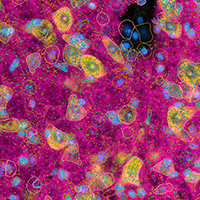
Integrated Spatial Transcriptomics Workflow
The Core can help investigators determine whether Visium HD, Xenium, or a complementary combination of approaches is most appropriate for a project. Visium HD provides an unbiased whole-transcriptome view for discovery, whereas Xenium provides highly resolved in situ analysis of selected gene panels. These approaches can also be integrated with single-cell or single-nucleus RNA sequencing to create comprehensive molecular and spatial maps of tissues.
Data Analysis and Bioinformatics
Spatial transcriptomics generates rich, multidimensional datasets that require specialized computational analysis. The Core provides or facilitates analysis workflows for quality control, dimensionality reduction and clustering, cell-type annotation, differential gene-expression analysis, spatial visualization, region-of-interest analysis, and integration with single-cell reference datasets. More advanced analyses can include spatial neighborhood analysis, cell-cell interaction studies, and comparison of molecular changes across experimental groups.
Project Consultation
Investigators are encouraged to contact the Core early in project development. Consultation before tissue collection and experimental design can help identify the most appropriate platform, tissue preparation strategy, sample numbers, experimental controls, and analysis plan. The Core can also assist with pilot studies and integration of spatial transcriptomics with other genomic, imaging, and functional datasets.
For questions, or to learn more about how the Core can enhance your research, please contact Core Director Shenfeng Qiu, MD, PhD.