How the airway, the ear, and sleep shape the developing brain — and how imaging and artificial intelligence can tell us sooner.
Research in the Department of Otolaryngology grew out of a question from the pediatric clinic: why do some children who snore struggle with attention, behavior, and learning, and which of them will benefit from surgery? Answering it has taken the department's investigators from polysomnography to optical brain imaging, from a single clinic to the nearly 12,000-child Adolescent Brain Cognitive Development (ABCD) Study, and from statistics to deep learning. The program is supported by the National Institutes of Health and is based on the Phoenix Biomedical Campus, where it works alongside the college's Department of Translational Neurosciences, Department of Radiology, and biostatistics faculty.
| 11,000+ children followed in the ABCD Study, the largest pediatric brain-imaging cohort in the United States | 5.5 million brain MRI slices segmented by our deep learning model to measure the upper airway | 284 children studied with functional near-infrared spectroscopy (fNIRS) during cognitive tasks | NIH R01 NHLBI-funded program on optical neuroimaging in pediatric sleep-disordered breathing |
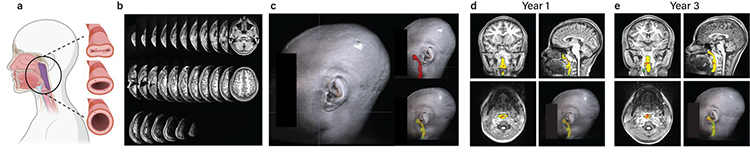
Measuring the airway from routine brain MRI. Every child in the ABCD Study receives a brain MRI, and the pharynx is captured incidentally at the bottom of each scan. A deep learning model outlines the airway in three dimensions and is applied across visits, with accuracy that held even when trained on as few as five hand-labeled scans. Kanhere, Navarathna, et al., Am J Respir Crit Care Med, 2025 (cover article).
Research focus areas
Population neuroscience of sleep-disordered breathing
Sleep-disordered breathing affects roughly one in ten children. Using the ABCD Study's longitudinal MRI, cognitive, and behavioral data, the department's investigators first showed that habitual snoring is associated with thinner frontal cortex and more behavioral problems (Nature Communications, 2021), then followed the same children for five years (JAMA Network Open, 2024). Work recognized by the Triological Society's Harris P. Mosher Award (2025) examined how apolipoprotein E genotype modifies the cognitive consequences of sleep-disordered breathing in adolescents. The airway measurements above replaced a parent's report of snoring with an objective anatomical exposure: larger airway volume was associated with larger temporal pole and orbitofrontal gray matter and with higher scores on eight of ten NIH Toolbox cognitive tests, and frontal and temporal gray matter carried a measurable share of the airway–cognition association.
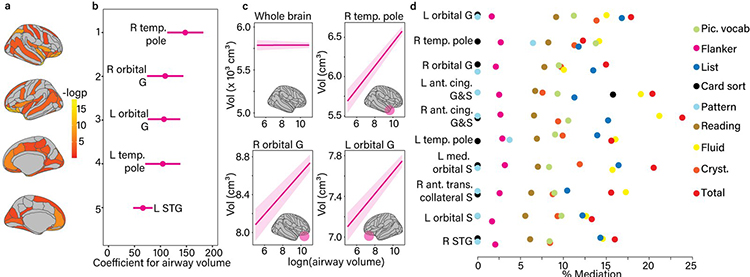
Airway volume predicts regional gray matter and cognition, and the brain sits in between. Larger airway volume was associated with larger temporal pole and orbitofrontal gray matter (a–c) and with higher scores on eight of ten NIH Toolbox cognitive tests. Mediation analysis (d) shows that frontal and temporal gray matter volumes carried a measurable share of the airway–cognition association, supporting a structural pathway rather than a purely behavioral one. Kanhere, Navarathna, et al., Am J Respir Crit Care Med, 2025.
Adenoids, tonsils, and the developing brain
Half a million children in the United States undergo adenotonsillectomy each year, selected largely by a visual grading of tonsil size that does not correlate with disease severity. In 11,127 children of the ABCD Study, the department's investigators segmented adenoids and tonsils from brain MRI with deep learning and defined relative adenotonsillar volume — the fraction of the upper airway occupied by lymphoid tissue. Tonsil and adenoid volume alone did not predict cognition, but the share of the airway they occupy did: larger relative volume was associated with lower attention and crystallized cognition scores, the deficits widened over four years, and the association was partially mediated by smaller frontal and insular cortices. The measure is heritable in twins (h² = 0.66) and fine-maps to a single intronic variant in TBX1, the principal dosage-sensitive gene of the 22q11.2 deletion, which colocalizes with associations for middle-ear and sinonasal disease. Relative adenotonsillar volume may help identify the children whose airway anatomy carries neurodevelopmental risk (Borda, Uddin, Navarathna, et al., 2026, under review).
Optical neuroimaging with fNIRS
Functional near-infrared spectroscopy (fNIRS) shines near-infrared light through the scalp and measures changes in oxygenated and deoxygenated hemoglobin in the cortex beneath — the same physiology that underlies functional MRI, but in a wearable cap that tolerates movement and costs a fraction of a scanner. Supported by an NIH R01 from the National Heart, Lung, and Blood Institute, the department has recorded prefrontal activity in 284 children aged 5 to 11 years during a Go/No-Go task of response inhibition at two academic centers. Greater disease severity — a higher apnea-hypopnea index or a lower oxygen saturation nadir — was associated with greater task-related activation of the left dorsolateral prefrontal cortex, yet neither severity measure predicted cognition directly. Prefrontal activation changed the relationship: in children with lower activation, worse sleep-disordered breathing tracked with lower NIH Toolbox scores, and in children with greater activation the association was absent or reversed. Prefrontal function appears to index resilience, a candidate biomarker for deciding who benefits most from treatment (Navarathna, Novi, et al., 2026), building on the department's earlier fNIRS studies of executive function in children with sleep-disordered breathing (Navarathna et al., Otolaryngology–Head and Neck Surgery, 2025; Nusraty et al., International Journal of Pediatric Otorhinolaryngology, 2026).
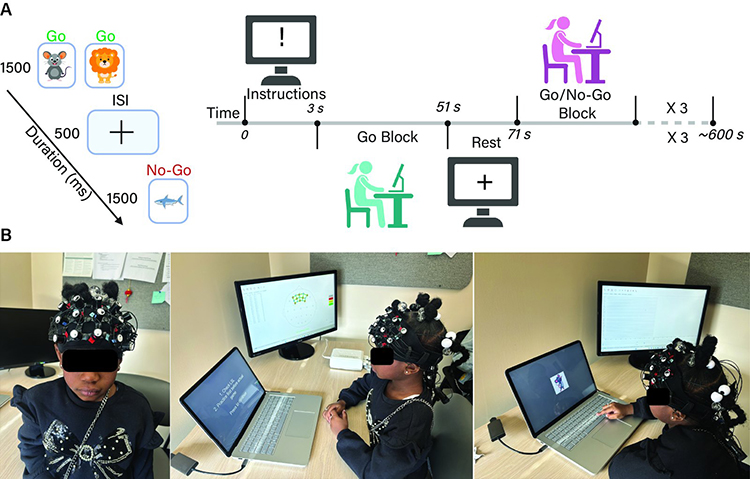
Task, recording, and analysis. Children respond to frequent "Go" cues and withhold responses to a rare "No-Go" cue (A) while wearing a 32-channel fNIRS cap (B). Optical signals are converted to hemoglobin concentrations, cleaned of motion and systemic physiology, and analyzed channel by channel across the prefrontal cortex. Navarathna, Novi, et al., 2026 (under review).
Upper airway imaging, deep learning, and the NEBULA framework
The upper airway is visible on every brain MRI, but it is rarely measured. The department's NEBULA framework (neuroimaging, airway, and genomics) uses deep learning to segment the upper airway and adenotonsillar tissue automatically from thousands of MRI scans — 5.5 million slices to date — and relates airway anatomy to brain structure, cognition, and genetic variation. A 2025 study in the American Journal of Respiratory and Critical Care Medicine showed that upper airway volume predicts brain structure and cognition in adolescents; the journal featured the work on its cover with an invited editorial. The lab runs its own GPU computing cluster for segmentation and model training.
Genetics and biology of hearing
With colleagues in the Department of Translational Neurosciences, the department studies the genetics of hearing loss and the cellular mechanisms of age-related hearing loss. Isabelle Schrauwen, PhD, leads the genomic analyses of the ABCD airway–brain program and studies the genetics of hereditary hearing loss and Jeong Han Lee, PhD, studies inner-ear hair cells, spiral ganglion neurons, and synaptic degeneration with aging.
Artificial intelligence and device innovation
A department review of 327 studies in JAMA Otolaryngology – Head & Neck Surgery (Novi et al., 2025) mapped where deep learning already performs at the level of specialists and where the evidence remains thin. In-house, the same methods power the airway segmentation pipeline and POLARIS, a language-model framework for phenotyping patients from the health record. Beyond the airway, TonoScan — a startup co-founded by department faculty — grew out of a discovery that the cornea's rebound after a natural blink depends on the pressure behind it, a signal that could enable home-based, continuous glaucoma monitoring without touching the eye.
Clinical outcomes across the subspecialties
Faculty at Banner MD Anderson and Barrow study outcomes in head and neck cancer surgery and reconstruction, transoral robotic surgery, cochlear implantation, and skull base surgery, and Barrow's neurotology group investigates imaging and virtual technologies for surgical planning. Residents join these projects from their first year.
Selected publications
- Kanhere A, Navarathna N, Yi PH, Parekh VS, Pickle J, Cloak CC, Ernst T, Chang L, Li D, Redline S, Isaiah A. Upper airway volume predicts brain structure and cognition in adolescents. Am J Respir Crit Care Med. 2025;211:2105–2116. doi:10.1164/rccm.202409-1748OC. Cover article, with an invited editorial (Tapia, Lee, and Arens, 211:1992–1993).
- Novi S, Navarathna N, D'Cruz M, Brooks J, Maron B, Isaiah A. Deep learning in otolaryngology — a narrative review. JAMA Otolaryngol Head Neck Surg. 2025. doi:10.1001/jamaoto.2025.3911.
- Navarathna N, Novi SL, Uddin S, Fong DC, Bortfeld H, Isaiah A. Assessing executive function in pediatric sleep-disordered breathing using functional neuroimaging. Otolaryngol Head Neck Surg. 2025;173(5):1264–1273. doi:10.1002/ohn.1351.
- Nusraty S, Navarathna N, Novi S, Bortfeld H, Mitchell RB, Isaiah A. Polysomnographic versus parent-reported predictors of executive function in children with sleep disordered breathing. Int J Pediatr Otorhinolaryngol. 2026;203:112766.
- Isaiah A. Apolipoprotein E (APOE) genotype and cognitive outcomes of snoring in a large cohort of adolescents. Laryngoscope. 2025. doi:10.1002/lary.32235. (Triological Society thesis; Harris P. Mosher Award.)
- Isaiah A, Uddin S, Cloak C, Ernst T, Li D, Chang L. Cognitive and behavioral outcomes of snoring in adolescents. JAMA Netw Open. 2024;7(11):e2444057.
- Isaiah A, Ernst T, Cloak CC, Clark DB, Chang L. Associations between frontal lobe structure, parent-reported obstructive sleep disordered breathing and childhood behavior in the ABCD dataset. Nat Commun. 2021;12:2205. doi:10.1038/s41467-021-22534-0.
- Isaiah A, Mitchell RB, eds. Snoring and Obstructive Sleep Apnea in Children: An Evidence-Based, Multidisciplinary Approach. Elsevier; 2023.
Collaborators and infrastructure
- University of Arizona College of Medicine – Phoenix: Department of Translational Neurosciences (genetics and hearing science), Department of Radiology (image analysis), and biostatistics faculty
- Adolescent Brain Cognitive Development (ABCD) Study — the largest long-term study of brain development and child health in the United States
- University of Maryland School of Medicine and the Institute for Genome Sciences — neuroimaging, sleep medicine, and genomics collaborators
- UT Southwestern Medical Center and Children's Medical Center Dallas, and the University of California, Merced — fNIRS study partners
- Department data science group with a dedicated GPU cluster for deep learning on medical images
Join our research
- Residents complete a protected research block in PGY-3 and can begin a project in their first year.
- Medical students join through the college's scholarly project program and the student otolaryngology research group forming in 2026–27. Projects include data-driven work with ABCD Study imaging, cognition, and genetics (R or Python, mixed-effects modeling, and manuscript preparation); clinical fNIRS studies on the Phoenix Biomedical Campus (recruiting, running cognitive tasks, and analyzing optical data); and AI and device work on segmentation, EHR phenotyping, and TonoScan validation. Summer, elective, and year-long research blocks are available. Interested students should contact the chair's office through Julia Diddy, Executive Assistant to the Chair (@email).
- Postdoctoral fellows, data scientists, and research coordinators: inquiries to @email.