Program Overview
The University of Arizona College of Medicine – Phoenix (U of A COM-P) is dedicated to educating future physicians, scientists and health care leaders through excellence in education, research, clinical care and community engagement. The college fosters a collaborative and innovative environment focused on advancing medical discovery and improving health outcomes for diverse communities.
Aligned with this mission, the Department of Biomedical Informatics offers a BMI Summer Internship Program for undergraduate and graduate students interested in biomedical informatics, artificial intelligence and data-driven health care innovation. The program provides hands-on exposure to the application of AI, data science and computational methods in biomedical research and health care.
Working alongside faculty mentors and interdisciplinary teams, interns contribute to projects involving data analysis, machine learning, algorithm development and translational informatics research. Through this remote experience, participants develop technical, analytical and professional skills while exploring how emerging technologies can help address real-world challenges in medicine and health care.
Program Logistics
The following schedule outlines the timeline for the 2027 BMI Summer Internship cohort.
- Application Window: January 11, 2027 – February 5, 2027.
- Program Dates: May 24, 2027 – August 13, 2027.
- Time Commitment: Interns are expected to participate full-time during the summer, with the option to continue part-time during the academic year as availability permits.
- Capacity: We select a small, focused cohort of up to six interns to ensure meaningful mentorship and project immersion.
- Stipend: Financial compensation is provided to support interns during the summer program.
The notice of our annual BMI summer internship is usually posted on LinkedIn (see a former post here) in early January.
To receive announcements and updates about future BMI Summer Internship positions, please contact internship program coordinator Erika ‘Yilin’ Zheng @email for more details.
Candidate Review & Selection
Target Participants: This program is tailored for students who have completed core coursework in computational or quantitative disciplines and are eager to tackle complex biomedical challenges.
Eligibility:
- Current second or third-year undergraduate students or graduate students.
- Majors in Data Science, Computer Science, Biomedical Engineering, Computational Biology, or related fields.
- Academic background including relevant coursework in applied mathematics, machine learning, or computational methods.
Preferred Experience: While we prioritize technical readiness and curiosity, successful applicants often demonstrate some familiarity with Python and common AI frameworks, alongside a passion for translational research.
Applications first undergo a resume review, in which candidates are evaluated based on prior experience, technical background, academic preparation, research exposure, and demonstrated interest in biomedical informatics, AI, and related fields.
Selected applicants are then invited to an initial interview to discuss their interests, goals, and project fit, followed by a second interview with potential faculty mentors or project leads to further assess alignment with ongoing research efforts. Final offers are extended based on overall fit, prior experience, demonstrated motivation, and alignment between candidates’ interests and available mentorship and projects.
BMI Signature Projects
Driven by advances in artificial intelligence, multimodal biomedical data and next-generation computational research, the biomedical informatics workforce increasingly requires expertise that spans data science, biology and health care. To prepare students for these emerging opportunities, the Department of Biomedical Informatics offers Summer Interns a portfolio of BMI Signature Projects that provide hands-on experience with real-world research challenges while building skills relevant to careers in biomedical informatics, artificial intelligence, bioinformatics, clinical research and digital health.
- SWDRC Metadata Schema Model (S2M2) mentored by Henning Hermjakob. This project focuses on standardizing how multimodal diabetes research datasets are described, shared, and integrated across the Southwest Diabetes Research Center consortium, while supporting interoperable metadata from multiple partner institutions.
- sMRI Agentic Preprocessing Assistant mentored by Dr. Dongren Yao. This project focuses on building an sMRI-focused agentic preprocessing assistant for VBM workflow guidance and FreeSurfer-based morphological feature extraction, enabling transparent, explainable, and quality-aware neuroimaging preprocessing.
- CARE AI Lite mentored by Jack Rincon and Irsyad Adam. This project focuses on developing and evaluating an AI assistant that uses evidence-based clinical communication frameworks to improve empathy, patient engagement, and response quality in healthcare conversations.
- Multimodal Proteomics + LLM mentored by Erika Zheng. This project focuses on developing a proteomics-centric multimodal foundational framework that integrates complementary biological modalities to improve predictive modeling, biological reasoning, and explainability in biomedical research
For additional information about current BMI Signature Projects, please contact Internship Program Coordinator Erika ‘Yilin’ Zheng at @email.
Instructor Team
We assembled an instructor team with multi-disciplinary expertise, including the following core members:
- Erika “Yilin” Zheng serves as the Lead Biomedical Informatics Technology Officer in the Department of Biomedical Informatics at the University of Arizona College of Medicine – Phoenix. Her expertise spans biomedical AI, computer vision, medical imaging, computational biology and biomedical informatics, with a focus on advancing technology and artificial intelligence applications in health care and research.
- Jack Rincon serves as the Director of Operations for the Department of Biomedical Informatics at the University of Arizona College of Medicine – Phoenix. His expertise includes workforce development, biomedical AI education and training program design, including national mentoring and training initiatives through the NIH Bridge2AI program.
- Henning Hermjakob serves as Chief Data Science Advisor to the Chair of Biomedical Informatics at the University of Arizona College of Medicine – Phoenix and leads Molecular Systems Services at EMBL-EBI. His expertise includes bioinformatics, systems biology, biological pathways, molecular interaction data and the development of globally adopted biomedical data resources.
- Dongren Yao is an Assistant Research Professor of Biomedical Informatics and Director of NeuroAI at the University of Arizona College of Medicine – Phoenix. His research focuses on artificial intelligence, neuroimaging and computational neuroscience, developing machine learning approaches to identify neurological disease biomarkers and advance brain health research.
- Irsyad Adam serves as a Data and AI researcher at the University of Arizona College of Medicine – Phoenix. His research centers on multimodal machine learning, knowledge graphs and large language models for precision medicine. His work integrates clinical and omics data to support disease prediction, therapeutic recommendations and explainable AI applications in health care.
Welcome 2026 BMI Summer Interns
The 2026 BMI Summer Internship Program was highly competitive, attracting more than 270 applicants from diverse backgrounds in biomedical informatics, computer science, biomedical engineering and related disciplines. Following a comprehensive review and selection process, we welcome an outstanding cohort of six students who contribute to a range of innovative research projects across the Department of Biomedical Informatics. The 2026 cohort includes:
- Joshua Paik – B.S. in Computer Science graduate from Purdue University and visiting researcher in the Sabuncu Lab at Cornell University.
- Tisha Thakkar – B.S. candidate in Computer Science at Georgia Institute of Technology, recently completed an AI Engineering internship at Codertroop Inc.
- Zaeem Qureshi – B.S. graduate in Biomedical Engineering and incoming M.S. student in Biomedical Engineering at Johns Hopkins University, previously a research intern at the National Center for Supercomputing Applications.
- Rohit Poduval – Junior majoring in Computer Science at the University of Minnesota, with prior research experience at the Health Intelligence Lab and Greenham Lab.
- Harmeet Singh – Junior pursuing a B.S. in Computer Science at the University of California, Irvine, with prior software engineering experience in the Underwater Robotics Project at UCI.
- Anson Ting – B.S. student in Computational and Systems Biology at UCLA, with prior research experience in the Fogel Lab at UCLA and the Longo Lab at Stanford School of Medicine.
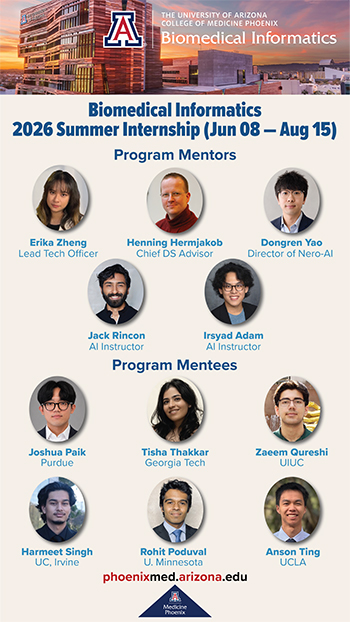
Over a 10-week period (June 8, 2026 – August 15, 2026), interns work closely with faculty, staff and mentors on projects spanning biomedical informatics, artificial intelligence, computational biology, data science and translational research. Through these experiences, participants contribute to ongoing research initiatives while developing the technical, analytical and professional skills needed to become the next generation of innovators in biomedical and health data science.