
Match Day Profile: Cindy Reynolds

Every third Friday in March, fourth-year medical students across the United States learn where the next chapter in their careers will be written. Match Day is the day when the National Resident Matching Program releases results to applicants in sealed envelopes, revealing where they will spend the next several years in residency, training in their chosen specialty. After years of preparation and study, it is a long-awaited and well-deserved day to celebrate. The University of Arizona College of Medicine – Phoenix is profiling several students for Match Day 2026.
Meet Cindy Reynolds
Cindy Reynolds was born in Texas and spent her early childhood years in Seoul, South Korea. She and her family moved back stateside when she was six years old and nestled in Phoenix, AZ, where they have called home ever since.
Reynolds’ passion for medicine began at a young age when sitting at the dinner table with her cardiac sonographer parents discussing complex health care terms like patent foramen ovale or tetralogy of Fallot, both being heart conditions.

This interested prompted her to study biochemistry, earning her bachelor’s degree from Arizona State University (ASU). She followed that with a master’s degree in the science of health care delivery at the same institution.
Throughout her educational journey, Reynolds has always counted her parents and friends as her biggest supporters. Her mom and dad worked long and demanding hours to help support her dreams, and they always pick up the phone when she has something on her mind.
And despite living across the globe, Reynolds has made it a priority to stay connected with her extended family in Seoul. That connection grounds her. She would not be who, or where, she is today without them
Path Toward Medicine
What was the spark that led you to become a physician?
I have always loved science, but I also love teaching and mentoring. As a chemistry teaching assistant in undergrad, I found so much joy in helping students understand tricky concepts and watching them become scientists. Medicine felt like the only career that allowed me to bask in the intersection of science, service and education. It’s deeply humbling to think that this will be my life’s work.
Choosing a Specialty
Do you have a specialty? What is it and why did it interest you, or what led you to it?
I will be going into general surgery. I began my medical school career thinking, “Absolutely no surgery,” so I scheduled my surgery rotations at the beginning of my third year to make certain I was medicine-bound.
Then I stepped up to the operating table.
In that moment, I realized that it was exactly what I had been looking for all along — immediate problem solving, technical skills and profound understanding of physiology. I spent the next seven weeks of my surgery clerkship trying to (unsuccessfully) convince myself that it wasn’t for me.
What’s Next
Post-Match Day, what are your goals moving forward?
After Match Day, I’m most looking forward to spending time with the people who helped me get here! I will be spending time in Seoul with my family before returning to be with my friends and family before residency begins.
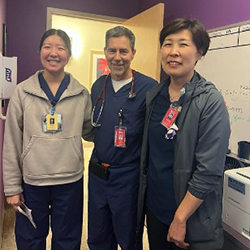
Long-term, I hope to work in a large, tertiary academic institution where I can care for complex patients while teaching residents and medical students to give back what I have received from my own training.
The College of Medicine – Phoenix Culture
What will you miss most about the College of Medicine – Phoenix? Any advice for incoming medical students?
As cheesy as it may be, I will miss the camaraderie of the College of Medicine – Phoenix. I’ve met some of my closest friends during my time at the college, and I am incredibly grateful for the mentors who pushed, supported and believed in me before I believed in myself.
To incoming students: welcome. We are thrilled to have you.
This will be one of the most meaningful seasons of your life, and at times, one of the most challenging. Medical school is hard. It will humble you. It will exhaust you. It will exasperate you. But it will also shape you into someone stronger, more compassionate and more capable than you ever thought possible.
Remember your “why” and hold onto it when times get tough. Remember why you started. Remember the patients you hope to serve. Remember the privilege and honor it is to be invited into a patient’s most vulnerable moments.
To err is human; to forgive – divine. Allow yourself the grace to learn, to struggle, to grow. To become.
About the College
Founded in 2007, the University of Arizona College of Medicine – Phoenix inspires and trains exemplary physicians, scientists and leaders to advance its core missions in education, research, clinical care and service to communities across Arizona. The college’s strength lies in our collaborations and partnerships with clinical affiliates, community organizations and industry sponsors. With our primary affiliate, Banner Health, we are recognized as the premier academic medical center in Phoenix. As an anchor institution of the Phoenix Bioscience Core, the college is home to signature research programs in neurosciences, cardiopulmonary diseases, immunology, informatics and metabolism. These focus areas uniquely position us to drive biomedical research and bolster economic development in the region.
As an urban institution with strong roots in rural and tribal health, the college has graduated more than 1,000 physicians and matriculates 130 students each year. Greater than 60% of matriculating students are from Arizona and many continue training at our GME sponsored residency programs, ultimately pursuing local academic and community-based opportunities. While our traditional four-year program continues to thrive, we will launch our recently approved accelerated three-year medical student curriculum with exclusive focus on primary care. This program is designed to further enhance workforce retention needs across Arizona.
The college has embarked on our strategic plan for 2025 to 2030. Learn more.