
White Coat Profiles – Nora Day

The White Coat Ceremony marks the first time a medical student will don his or her white coat, the defining symbol of a physician. The coat bestows a great honor on each student, and with it comes a responsibility to uphold the trust of every patient they will encounter. The Class of 2030 will receive their white coats on July 17 during a ceremony that begins at 3:30 p.m. in the North Ballroom of the Phoenix Convention Center.
Meet Nora Day
Born and raised in Phoenix, Arizona, Nora Day has always considered the desert home. She earned her bachelor’s degree in rehabilitation studies and services from the University of Arizona and then completed a Master of Public Health at New York University, where she focused on health care policy and management.
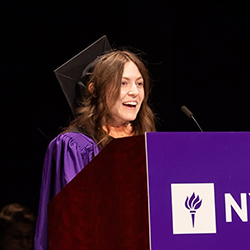
For Day, returning home to attend the U of A College of Medicine – Phoenix feels like coming full circle. Her biggest supporters have always been her parents and brother, who taught her the power of determination and resilience and encouraged her to never limit her potential.
She has also been incredibly fortunate to have mentors, professors, physicians and friends who believed in her long before she believed in herself.
Path toward Medicine
What was the spark that led you to become a physician?
People often assume my path to medicine began because I grew up navigating the health care system as a patient with a spinal cord injury and underlying cerebral palsy. While those experiences did shape me, one moment stands out above the rest. When I was preparing for my senior year prom, I asked one of my physicians if I could wear heels instead of my leg braces for a few hours. His response was simple: "It's not important."
He only meant that my appearance wasn't worth the risk, but what I heard was that something deeply important to me had been dismissed. Years later, I found words for that feeling in a poem by Mary Oliver, "Joy is not made to be a crumb." What seemed insignificant to someone else represented confidence, belonging and a milestone I had dreamed about.
That experience taught me that excellent medical care isn't just about making the safest clinical recommendation, but rather, it's about understanding what matters to the person sitting in front of you. I left that appointment determined to become the kind of physician who asks, "What is important to you?" before deciding what's important medically. I hope to build a career where patients feel heard as people first and diagnoses second.
Did you do any volunteering in health fields prior to medical school?
Before medical school, I sought opportunities to serve patients and advocate for more equitable health care in a variety of settings. I participated in Street Medicine, providing care and resources to individuals experiencing homelessness; and held leadership roles in reproductive health care advocacy, where I worked to improve access and education.
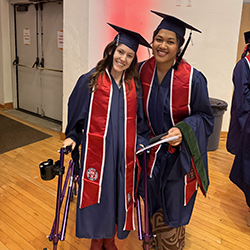
One project that remains especially meaningful to me was creating a self-advocacy curriculum for young women with disabilities. While I’m still hoping to pilot the program one day soon, developing it reinforced my belief that patients deserve the knowledge and confidence to participate actively in their own health care decisions. Whether through direct service or advocacy, I've always been drawn to helping people find their voice within the healthcare system.
The College of Medicine – Phoenix
Why did you choose the College of Medicine – Phoenix?
Choosing the College of Medicine – Phoenix felt like choosing home. I was born here, received care throughout my childhood at Phoenix hospitals, including Phoenix Children's, and many of the physicians who shaped my own journey trained or practiced in this community.
Beyond the personal connection, I was drawn to the college’s commitment to serving Arizona's diverse patient population, its close-knit learning environment and its emphasis on collaborative, compassionate, patient-centered care. It feels incredibly meaningful to return to the community that invested so much in me and begin the journey toward giving back as a future physician.
What excites you most about beginning medical school?
I'm excited to finally begin learning the science behind medicine while also learning from patients. I've spent years imagining this moment, and I know medical school will challenge me in ways I can't fully anticipate. I'm looking forward to growing alongside classmates who are passionate about caring for others and learning from faculty who are dedicated to shaping the next generation of physicians. More than anything, I'm excited for the privilege of meeting patients and earning their trust. Every interaction will be an opportunity to become not only a better physician, but a kinder person.
Significance of the White Coat
What does the white coat mean to you?
To me, the white coat represents far more than a milestone in medical education. Instead, it represents the responsibility to ensure every patient feels like they belong in health care. As someone who has navigated the health care system with a disability, I know how meaningful it is when a physician creates an environment where patients feel respected, included and understood.
Representation matters — not because patients need physicians who look exactly like them, but because they deserve physicians who recognize that every person's experience is different and worthy of respect. When I put on my white coat, I'll be thinking about the patients who have ever felt overlooked, underestimated or unheard. I hope to be the kind of physician who helps change that by being someone who listens first, adapts when needed, and makes every patient feel like they belong in the exam room.
Ultimately, for me, the white coat symbolizes compassion, inclusion and the opportunity to build a health care system where every patient can see themselves reflected in the care they receive. On a more personal note, I hope that one day a child with a disability walks into my exam room and sees not someone who overcame their disability, but someone who shows them that they belong in medicine, in health care and in every room they dream of entering.
About the College
Founded in 2007, the University of Arizona College of Medicine – Phoenix inspires and trains exemplary physicians, scientists and leaders to advance its core missions in education, research, clinical care and service to communities across Arizona. The college’s strength lies in our collaborations and partnerships with clinical affiliates, community organizations and industry sponsors. With our primary affiliate, Banner Health, we are recognized as the premier academic medical center in Phoenix. As an anchor institution of the Phoenix Bioscience Core, the college is home to signature research programs in neurosciences, cardiopulmonary diseases, immunology, informatics and metabolism. These focus areas uniquely position us to drive biomedical research and bolster economic development in the region.
As an urban institution with strong roots in rural and tribal health, the college has graduated more than 1,000 physicians and matriculates 130 students each year. Greater than 60% of matriculating students are from Arizona and many continue training at our GME sponsored residency programs, ultimately pursuing local academic and community-based opportunities. While our traditional four-year program continues to thrive, we will launch our recently approved accelerated three-year medical student curriculum with exclusive focus on primary care. This program is designed to further enhance workforce retention needs across Arizona.
The college has embarked on our strategic plan for 2025 to 2030. Learn more.