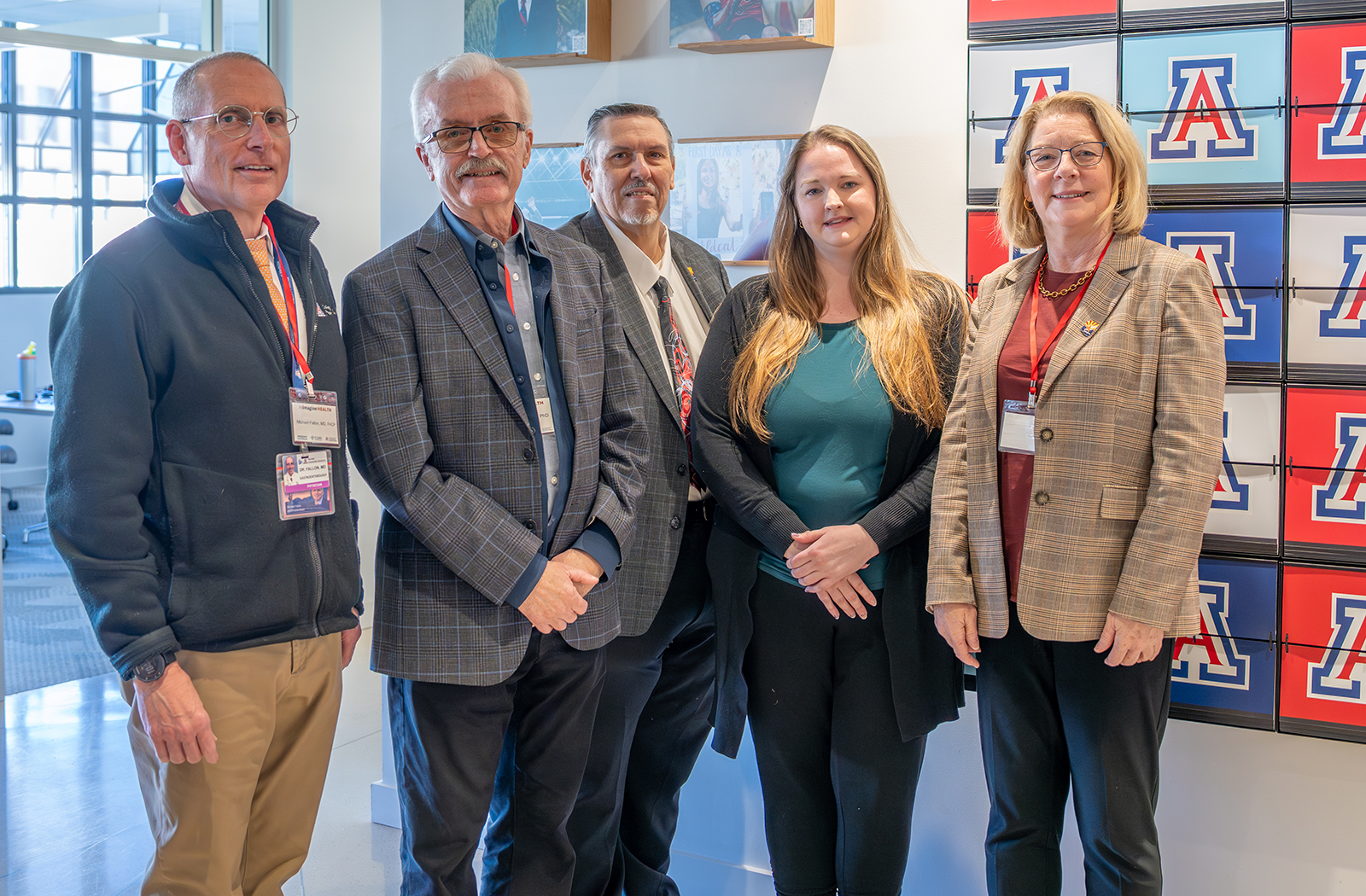
reimagine Health Research Symposium Analyzed the Different Components of Aging

According to Nature, aging is considered the process during which structural and functional changes accumulate in an organism because of the passage of time, manifesting into a decline from the organism’s peak physiological functions and fertility.
Through the 8th Annual reimagine Health Research Symposium, the University of Arizona College of Medicine – Phoenix sought to examine the many aspects of aging and human resilience.
Chris Glembotski, PhD — vice dean of Research, professor of Internal Medicine and director of the Center for Translational Cardiovascular Research — opened the symposium and provided a preview of what the goals and outcomes were for the event.

“We have speakers that are going to be addressing the different aspects of aging: cell and molecular, clinical and social and environmental,” Dr. Glembotski said. “We tried to put together a program that would combine all of these so you could see what the current state of aging research is.”
Janko Nikolich, MD, PhD, associate dean for Research and Partnerships at the U of A College of Medicine – Phoenix, discussed the defects of immunity with aging and how to fix them.
According to Dr. Nikolich, the immune system is primarily involved with two sides of aging: an acute side and a chronic side. The acute side notes that with aging, immunity to new primary infection is blunted, leading to a decline that is often life-threatening to the aging host.
The chronic side highlights how a dysregulation of immunity can accelerate or even induce age-related tissue dysfunction or diseases.
“Age-related changes in secondary lymphoid organs, lymph nodes and spleen substantially erode protective immunity,” Dr. Nikolich said. “All stromal cells exhibit the loss of architecture and numerical loss of some cell types and metabolic stress of others.”
Anthony Molina, PhD, a professor of medicine at the University of California San Diego, joined the symposium to present on biological resilience and healthy aging.
According to Dr. Molina, the three domains of resilience that are intimately linked with healthy aging are one’s ability to resist functional consequences of the physiological changes with aging, one’s ability to adapt to functional changes and one’s ability to recover and avoid physiological stressors.
“Our genetics and our chronological age define our baseline mitochondrial health,” Dr. Molina said. “But our behaviors, nutrition, lifestyle and the environment we live in influence the rate and trajectory of these bioenergetic changes over time.”
In her presentation, Amelia Gallitano, MD, PhD, professor of Basic Medical Sciences, Psychiatry and Translational Neurosciences at the College of Medicine – Phoenix, focused her remarks on how to build health resilience in a warming world.
She emphasized that the climate is changing rapidly. Global heating has been more rapid than expected — with the rate doubling since 2010. Five of the last six hottest years in Arizona occurred in the last six years, with 2024 being the hottest on record.
To combat this, Dr. Gallitano shared some of the solutions related to making the state of Arizona an incubator for technological developments that address health-related ailments of heat.
“We’re developing asynchronous learning modules to address the problem of heat-related illness in our medical education system,” Dr. Gallitano said. “You may know that different medication can increase people’s susceptibility to heat, so we’re working on technologies to get that information most effectively and efficiently to patients when a prescriber writes a prescription.”
Eugene Livar, MD, Arizona’s first Chief Heat Officer, added to the conversation of climate change adaption and discussed the unseen toll of extreme weather, as well as how it ties in with environmental stress and human resilience.
According to Dr. Livar, extreme heat exacerbates chronic conditions — such as cardiovascular disease, diabetes and respiratory illnesses. Extreme heat can also lead to psychological and financial burdens if the temperature remains elevated.

“When temperatures remain dangerously high overnight, sleep is often impossible for those that don’t have appropriate air conditioning available to them,” Dr. Livar said. “Lack of sleep leads to chronic stress and poor-decision making. We often see with increased temperatures there is an increase in crime and battery.”
Throughout the presentation, Dr. Livar shared the various ways people are addressing the heat such as developing heat relief sites, engineered artificial canopies, reflective roofs and new road technologies that are made to reduce the urban heat island effect.
“Resilience is not just surviving the heat,” Dr. Livar said. “It is the capacity of our systems and communities to adapt, recover and thrive despite it.”
The symposium also featured presentations by James Kirkland, MD, PhD, director of the Center for Advanced Gerotherapeutics at Cedars-Sinai Medical Center; Edward Lakatta, MD, professor in the Department of Medicine and Cardiology at John Hopkins University School of Medicine; and David Furman, PhD, director of the Stanford 1,000 Immunomes Project at Stanford School of Medicine and associate professor at the Buck Institute for Research on Aging.
The symposium was hosted by the College of Medicine – Phoenix’s Translational Research Office. Sponsored annually by the Arizona Biomedical Research Centre and the Flinn Foundation, the event concluded with a panel discussion with several experts on the field. Following the discussion, the event hosted a networking reception for those that attended.
About the College
Founded in 2007, the University of Arizona College of Medicine – Phoenix inspires and trains exemplary physicians, scientists and leaders to advance its core missions in education, research, clinical care and service to communities across Arizona. The college’s strength lies in our collaborations and partnerships with clinical affiliates, community organizations and industry sponsors. With our primary affiliate, Banner Health, we are recognized as the premier academic medical center in Phoenix. As an anchor institution of the Phoenix Bioscience Core, the college is home to signature research programs in neurosciences, cardiopulmonary diseases, immunology, informatics and metabolism. These focus areas uniquely position us to drive biomedical research and bolster economic development in the region.
As an urban institution with strong roots in rural and tribal health, the college has graduated more than 1,000 physicians and matriculates 130 students each year. Greater than 60% of matriculating students are from Arizona and many continue training at our GME sponsored residency programs, ultimately pursuing local academic and community-based opportunities. While our traditional four-year program continues to thrive, we will launch our recently approved accelerated three-year medical student curriculum with exclusive focus on primary care. This program is designed to further enhance workforce retention needs across Arizona.
The college has embarked on our strategic plan for 2025 to 2030. Learn more.